Bernard Stiegler: technics, politics, individuation

March 7th, 2013

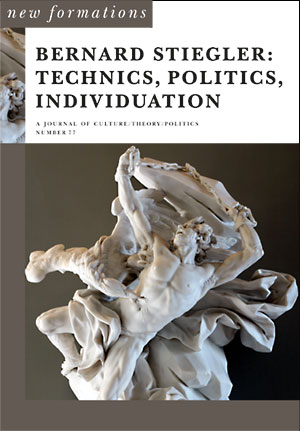
nfThe issue of New Formations which I have been editing with Jeremy Gilbert has come out. It includes a new interview with Stiegler. This is the table of contents: Table of contents:

Editorial pp. 5-7(3)
Gilbert, Jeremy; Roberts, Ben

Technics, Individuation and Tertiary Memory: Bernard Stiegler’s Challenge to Media Theory pp. 8-20(13)
Author: Roberts, Ben

Enchantment, Disenchantment, Re-Enchantment: Toward a Critical Politics of Re-Individuation pp. 21-43(23)
Author: Barker, Stephen

Technics Beyond the Temporal Object pp. 44-62(19)
Author: Hansen, Mark B.N.

The Reality of Real Time pp. 63-75(13)
Authors: Wambacq, Judith; Buseyne, Bart

The Forgetting of Aesthetics: Individuation, Technology, and Aesthetics in the Work of Bernard Stiegler pp. 76-96(21)
Author: Ieven, Bram

Editing (and) Individuation pp. 97-110(14)
Author: Crogan, Patrick

Life and Thought in the Rushes: Mnemotechnics and Orthographic Temporal Objects in the Philosophy of Bernard Stiegler pp. 111-126(16)
Author: Swiboda, Marcel

Proletarianisation pp. 127-149(23)
Author: Hutnyk, John

Antagonism and Technicity: Bernard Stiegler on Eris, Stasis and Polemos pp. 150-163(14)
Author: Marchart, Oliver

Bernard Stiegler: ‘A Rational Theory of Miracles: on Pharmacology and Transindividuation’ pp. 164-184(21)
Authors: Stiegler, Bernard; Roberts, Ben; Gilbert, Jeremy; Hayward, Mark

Glossary pp. 185-186(2)

War at the Membrane pp. 187-191(5)
Author: Thoburn, Nicholas

Unconsoled pp. 192-195(4)
Author: Graham, James

Beyond the Everyday pp. 196-200(5)
Author: Ganguly, Keya

Post-Cinematic Effects pp. 201-203(3)
Author: Bowman, Paul

Baldwin’s Atlantics pp. 204-208(5)
Author: M’Baye, Babacar

Resisting Deconstruction pp. 209-213(5)
Author: Macdonald, Molly

Paying Attention

July 26th, 2012

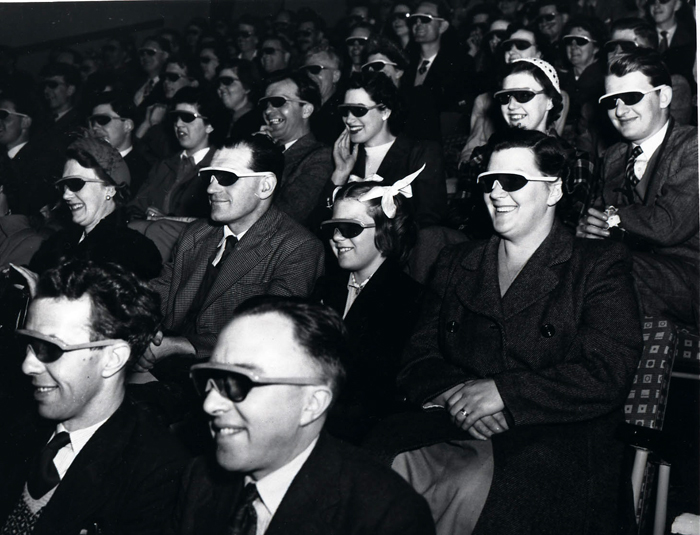
The Fifties in 3D, from the National Archives UK

A new special issue of Culture Machine, in which I have an article, has been published. It is a special issue on the topic of ‘Paying Attention’ collecting papers given at the ESF conference of the same name in Sweden in 2010. As the editors of the issue, Patrick Crogan and Samuel Kinsey, put it:

How are the ways we understand subjective experience – not least cognitively – being modulated by political economic rationales? And how might artists, cultural theorists, social scientists and radical philosophers learn to respond – analytically, creatively, methodologically and politically – to the commodification of human capacities of attention?

My own article is called ‘Attention-seeking: Technics, Publics and Software Individuation’ and is basically concerned with arguing against the usefulness of the concept of ‘attention economy’ as a way of understanding free software communities. It also looks critically at Christopher Kelty’s concept of the recursive public, as articulated in Two Bits: the Cultural Significance of Free Software.

‘Waiting for the Political Moment’

December 1st, 2009

An interesting Call For Papers from Bram Ieven at Utrecht for an event called ‘Waiting for the Political Moment‘:

CALL FOR PAPERS

WAITING FOR THE POLITICAL MOMENT

Utrecht & Rotterdam, June 17-19, 2010

Convened by Frans-Willem Korten and Bram Ieven

Sponsored by Stichting Letteren en Samenleving Rotterdam, Erasmus Trust Fund Rotterdam, the Centre for the Humanities and the OGC at Utrecht University, The Faculty of History and Art of the Erasmus University Rotterdam, and the City of Rotterdam.

Hamm: What’s happening?

Clov: Something is taking its course.’

Beckett, Endgame

Over the last decades, several political and cultural theorists have argued that the domain of politics, and even the very idea of the political, has been hollowed out. Politics today appears to have lost its proper status or has been submerged in the more powerful and encompassing infrastructures of late capitalism. Instead of frantically affirming or denying the emptying-out of the political, this conference traces the appropriation of the political by apparatuses of state, church, capitalism and media in modernity to look for ways to reinvigorate it. To do so, the conference focuses on a key concept: the political moment – the moment in which political agency becomes possible, as well as the formative role of the moment in politics.

To get to grips with the political moment we not only need to understand our current moment; we need to have an idea of how it developed over time. Not considering the political moment from an exclusively contemporary point of view, this conference also calls for proposals that focus on the formation of the political in relation to its emptying-out from the late Middle Ages to the present.

Contributions in the form of a 4000 words positioning paper distributed in advance and to be discussed in a seminar setting could address (but are not limited to) the following issues: what is a political moment? What does the emptying-out of the political imply? How has the appropriation of the political by state, religion or media shaped the conditions of possibility of the political? What is the role of the moment in politics?

Confirmed speakers include: Mieke Bal, Bruno Bosteels, Rosi Braidotti, Simon Critchley, Martin van Gelderen, Olivier Marchart, Patchen Markell, Benjamin Noys, and Alberto Toscano.

If you are interested in participating, please send in a 300-words paper proposal and a short résumé of your current research by January 15 2010 to Frans-Willem Korsten, Professor of Literature and Society, Erasmus University Rotterdam, email: korsten@fhk.eur.nl; and/or to Bram Ieven, lecturer in comparative literature at Utrecht University, email: b.k.ieven@uu.nl.

For more information see: www.waitingforthepoliticalmoment.org

Beyond the ‘Networked Public Sphere’: Politics, Participation and Technics in Web 2.0

November 10th, 2009
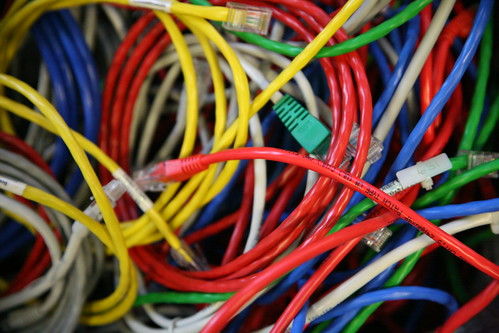
Tangled Network, by Bruno Girin, used under CC-BY-SATangled Network, used under CC-BY-SA

by Bruno Girin

I’ve just published an article in the new issue of the open access journal Fibreculture. This is the abstract:

This paper argues for a sceptical approach to the political promise of Web 2.0. In particular it examines critically the claims made about participation and the ‘network public sphere’ in Yochai Benkler’s The Wealth of Networks. Moreover it argues that the work of Bernard Stiegler and that of others in the Ars Industrialis group cofounded by Stiegler can help inform a more nuanced account of the relationship between politics, participation and technics. It looks specifically at the arguments in Marc Crépon and Bernard Stiegler’s recent book De la démocratie participative, written during the recent French presidential campaign, and examines how the idea of participation articulates with key themes in Stiegler’s philosophy of technics. Finally it suggests some ways in which this debate on participation might be moved on.

Saving media institutions

March 16th, 2009
new-york-times-bulding by Kevin Prichard, used under a href=New York Times Building, used under CC-BY-SA

by Kevin Prichard

Felix Salmon thinks the New York Times should go nonprofit.

The end of newspapers

March 16th, 2009

Clay Shirky, Nicholas Carr and Yochai Benkler on the end of newspapers.

Links for workshop on new media

February 8th, 2007

These are the links for my presentation at a teachers’ workshop entitled ‘”Broadcast Yourself”: how the internet is transforming traditional media’.

On wikipedia

Nature report on wikipedia which concluded that, for a subset of science articles, it was not not much less reliable than the Encyclopedia Britannica:

http://www.nature.com/news/2005/051212/full/438900a.html

Encyclopedia Britannica‘s response to Nature report:

http://corporate.britannica.com/britannica_nature_response.pdf

Nature‘s rebuttal of Encylopedia Britannica:

http://www.nature.com/nature/britannica/eb_advert_response_final.pdf

The Guardian: Can you trust wikipedia?:

http://technology.guardian.co.uk/opinion/story/0,16541,1599325,00.html

On white phosphorus story

Correntwire blog entry on White Phosphorus which provided links to online sources showing the U.S. military had used White Phosphorus in Falluja:

correntwire blog story

BBC News story on White Phosphorus (largely a write up of the blogs):

http://news.bbc.co.uk/1/hi/world/americas/4442988.stm

BBC news journalist reflects on the power of blogging in the wake of the white phosphorus story:

http://news.bbc.co.uk/1/hi/world/4696668.stm

Bill Thompson (BBC technology commentator) on the power of blogging:

http://news.bbc.co.uk/1/hi/technology/4492150.stm

New Media and Copyright Issues

Presentation on ‘Free Culture’ given by Lawrence Lessig in 2002 at the OReilly Open Source Conference. Note that this is a flash presentation with embedded audio of Lessig speaking:

http://randomfoo.net/oscon/2002/lessig/free.html

Lessig’s book, Free Culture, is freely available online:

http://www.free-culture.cc/freeculture.pdf

youtube clips played

http://youtube.com/watch?v=z8SYHxlH9mI

http://youtube.com/watch?v=DLqCM16i6QY

Unbounded Freedom

October 11th, 2006

(via Lawrence Lessig): Unbounded Freedom is the title of a new book by Rosemary Bechler which is billed as a ‘a guide to Creative Commons thinking for cultural organisations’ and is backed by the British Council.

The book is freely available online under a Creative Commons license. It seems as if it could be a useful resource for teaching as well as cultural organisations.

Lessig and Anderson on the Rise and Fall of the Blockbuster

September 29th, 2006

Luis Villa has a writeup of a debate between Lawrence Lessig and Chris Anderson (or, as Villa puts it, ‘Mr Free Culture‘ and ‘Mr Long Tail‘) at the New York Public Library. It seems to be a pretty interesting discussion about the interersection between Anderson’s argument about the long tail (i.e. that internet distribution renders the blockbuster obsolete and creates instead a mass of niche markets) and the IP issues that interest Lessig.

It’s a shame there’s not (yet?) audio or a transcript of the debate. Some of these NYPL talks do appear to be available online so maybe it will turn up one day.

De-Scribed on User-Generated Content

September 22nd, 2006

De-Scribed has an interesting post on the question of whether User-Generated Content, (as visible on Myspace, Youtube etc) really represents a new media paradigm:

The fact is that the new media paradigm wouldn’t be possible without an already existant brand-saturated culture. In other words, the vast majority of user-generated content – the volume with which YouTube, MySpace, etc depend upon to maintain some future – is built up around the “branding” of the people involved. Reviews, comments, demonstrations, novelty sneak-peeks, even “what I like” lists… We define ourselves according to what we buy, what we watch and what we listen to, and so our communications, and our “social indicators” (i.e. things that say “who will like me?”) reflect this utterly.

Up to a point I would have to agree with this scepticism, in the sense that a large amount of user-generated content could be as derivative from ‘old media’ content. However I can think of two responses to this. The first, an old media studies argument, is that it doesn’t necessarily follow from the basically parasitic nature of ‘fan culture’ that nothing interesting, creative or original is going on there. Bands and brands (or bands as brands) can be seen as providing contexts for conversations that are not solely defined or limited by those contexts.

The second response is that the fact that user-generated content is both coexisting and interacting with ‘big’ media doesn’t necessarily stop it from representing a genuinely new form of media: new media forms often seem to sit alongside old media forms without entirely replacing them. If the criterion for a form of media to be recognised as radical or a new paradigm is that it be a total break with existing cultural forms and conventions then we could be waiting for a very long time….